The Map We Would Build for a Sacramento Personal Injury Firm
The map we would build for a Sacramento personal injury firm starts where the firm’s own site usually stops, with the questions a firm has to answer to be found when an injured person searches. If you have heard that pain and suffering is medical bills times some number between one and five, here is where that comes from: nowhere in the instruction the jury actually hears.
California gives jurors CACI 3905A when they decide what pain and suffering is worth. It contains no formula and no multiplier. It tells them there is no fixed standard. That number has no source in the only document that governs the decision.
That is one page. There are a hundred and fifty to two hundred questions in the map, and this is one of the sharper ones.
What this is
This is the complete content programme we would build for a personal injury firm in Sacramento, derived rather than estimated. Every page on it answers one question a claim actually raises, and names the statute, rule or jury instruction that answers it.
You are looking at the structure. None of these pages has been written. We are showing you the map before the work, because the map is the part you are actually buying.
Sacramento is the example, not the limit. The same derivation runs for any state, any city, any county. The statutory layer changes with the state, the court procedure changes with the county, and the method does not change at all. It runs for other practice areas too, and some of them derive larger than this one.
What your firm gets from it
You become the firm the answer comes from.
Someone has just been hurt. Before they compare reviews, before they read a single advertisement, they ask an assistant the question they need answered right now. How long do I have to sue. Is the owner of the dog liable. What is a case like mine actually worth.
The assistant answers from whatever published source covers that question properly, and it says where the answer came from. A firm that has answered the question is the firm that gets named.
That is a case that reached you before it reached anyone else. No auction, no click, no ten tabs of firms who all say the same three things. It happened at the point where the person still has a decision to make rather than a shortlist to choose from, and it happened because you were the only one who had written the answer down.
That is the product. Not traffic, not impressions, not a ranking report. Being the source the answer comes from, on the questions people ask before they are ready to call anybody.
Why it compounds, and why advertising does not
An advertisement works while the budget runs and stops on the day it stops. You are renting the position, you are renting it against everyone else who wants it, and next year it costs more.
A complete map does the opposite, for two reasons you can check rather than take on faith.
The pages hold each other up. A page on the six-month deadline for suing a city is easier to find because the pages around it explain what counts as a public entity, what happens when that deadline is missed, and what the deadline is for everyone else. Each page you add makes the ones already published easier to reach.
And completeness is what earns the standing in the first place, which means the pages are not worth the same as each other. The hundred and fiftieth is worth more than the fifteenth, because it is the one that finishes the coverage, and being complete is what gets a firm treated as the source rather than as one more site with pages about the topic.
That is the case for building the whole thing rather than buying clicks: when it is finished it is finished, and it is yours. It keeps working on the day you stop paying for it, which is the day an advertising programme stops working entirely.
We measure this on ourselves rather than asking you to believe it. Our own AI search visibility, measured publishes a frozen set of prompts, keeps the raw responses, and re-runs identically, so the claim can be checked instead of asserted. We would rather show you a measurement of our own work than a case study about someone else’s.
How this works in search, in plain terms
Search engines and AI assistants do not reward more pages. They reward complete coverage of a subject.
The term for that is topical authority, and it means something specific: being the source that answers every question a subject contains, rather than the source with the most pages about it. A site with forty pages that answer forty different questions beats a site with two hundred that circle the same six.
Completeness is measured against the subject, not against your competitors. This is the part most people get backwards. If nobody in Sacramento has answered a question, publishing nothing about it is not “keeping up”, it is a gap sitting in plain sight. The questions a personal injury claim raises exist because the law creates them, whether or not anyone has typed them into a search box yet.
That is why we derive the map from the law instead of from a keyword tool. A keyword tool tells you what people have already searched. It cannot tell you what the subject contains, so it cannot tell you when you are finished.
The map
Every claim, whatever kind it is, travels the same seven stages. It has to exist, have someone to sue, be brought in time, be valued, be reduced by insurance and fault, be resolved, and be talked about within the advertising rules. A reader works through them in that order and cannot skip one.
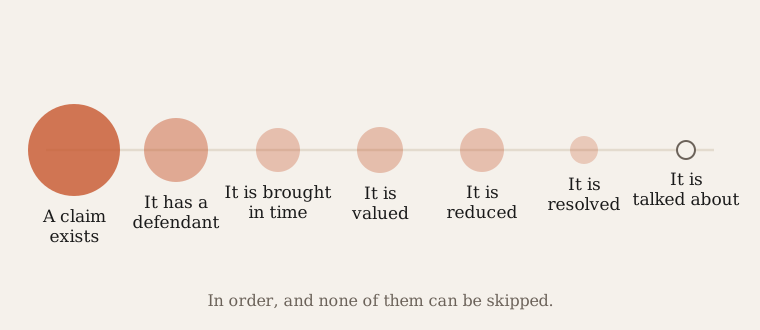
The stages are the same for a rear-end collision and a nursing home case. What changes is how much each kind of claim has to say at each stage.
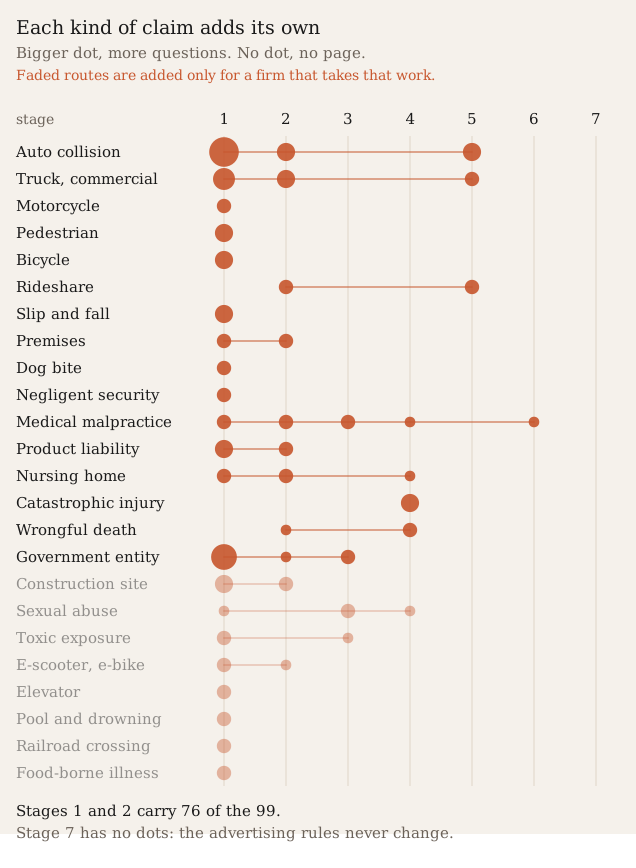
Where a route has no dot, we do not write a page. A motorcycle case and a car case are valued the same way, so that is one page and not two. That single rule is the difference between a map and a list of titles.
Why it is this long, and not longer
The rule is simple to state and it is what keeps the number honest:
One page per question a reader has to resolve, where a named source gives a different answer.
Not one page per statute. Not one page per keyword. If the answer for a motorcycle claim is the same as the answer for a car claim, it is one page.
A programme padded to two hundred pages by publishing one answer under fifteen headings is worth less than thirty pages that each answer something, because the fifteen compete with each other and none of them is the complete answer to anything.
Every page on the map, listed
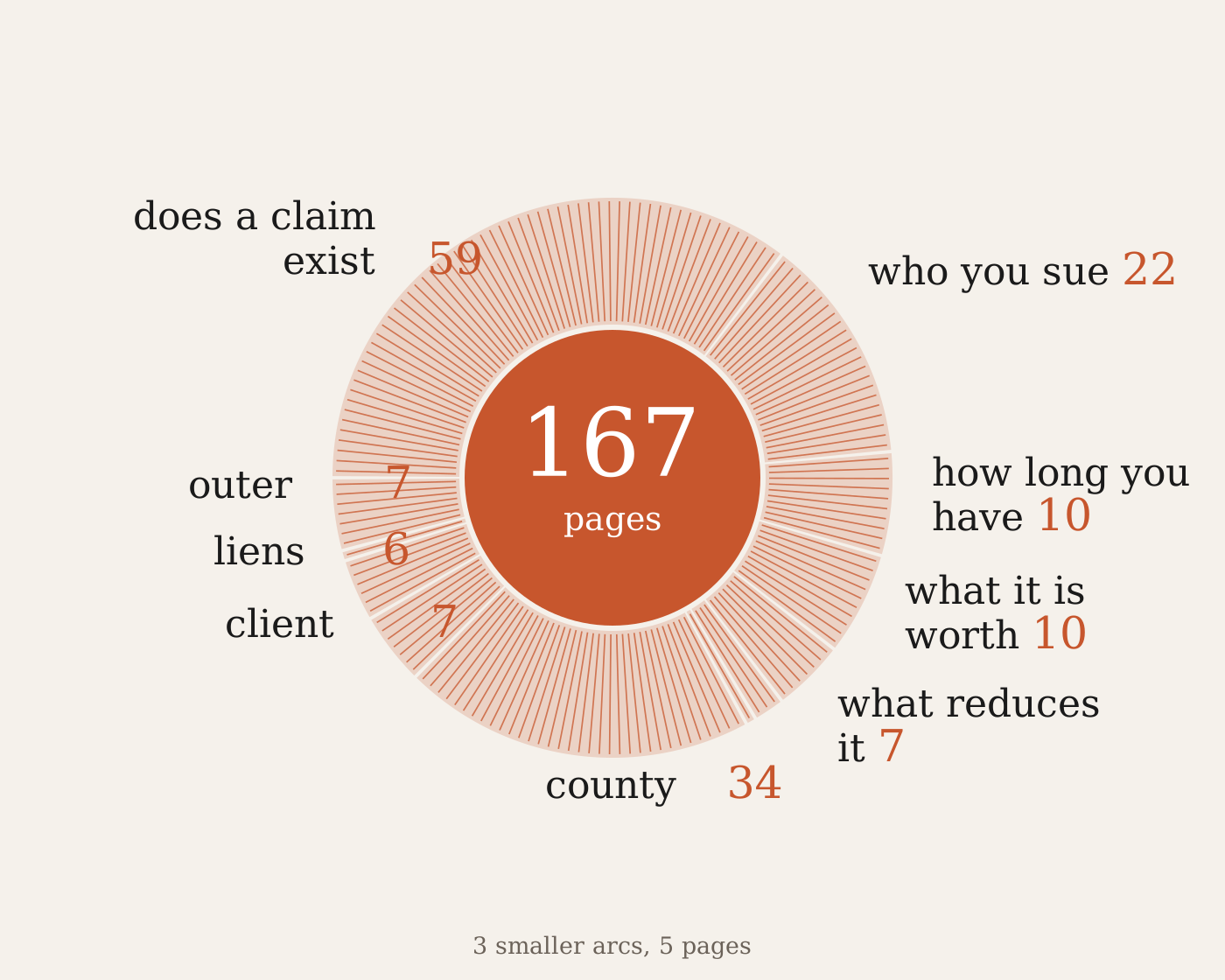
Each spoke is one page and each arc is a stage of a claim. The width of an arc is how much of the work sits there, which is why the first two arcs take half the circle between them. Below is the same map as text, every title readable, nothing collapsed on arrival.
167 titles, and you can read every one of them. They are grouped the way the map is derived: by the stage of a claim they answer, then by the kind of claim that raises them. Every branch shows its count. Collapse any of them to navigate; nothing is hidden on arrival.
The citation after a title is the authority that answers it. 106 of the 167 carry one. 61 do not, and rather than let you find that by counting: 30 are the ten counties outside Sacramento that nobody has read yet, 7 are questions of a kind no authority answers by definition, and the remaining 24 are mostly doctrines a court decided rather than a legislature wrote, where the source is real and we have not yet pinned the case.
That is 37 per cent of the list with no citation, and it is the number we would least like to publish. It is here because a map that hides its own gaps is the thing this page exists to argue against.
These 61 are not the projected pages, and the two must not be added together. A projected page is one nobody has found yet, so it is not on this list at all. An uncited title is a page we have identified and whose source we have not yet named. Different things, counted separately.
These branch counts include the shared questions as well as the claim-specific ones, so they run higher than the figures above, which count only what a kind of claim adds. Both are correct and they are counting different things.
Stage 1, does a claim exist 59
Every claim, whatever kind 4
- When someone is careless and you are hurt, and what happens if you were careless too (Civ. Code 1714(a))
- Suing the company for what its employee did (Civ. Code 2338)
- Getting hurt on land left open for recreation (Civ. Code 846)
- Buses, trains and lifts: the higher duty a carrier owes (Civ. Code 2100)
Auto collision 6
- The speed limit is not the whole answer: the basic speed law (Veh. Code 22350)
- Rear-end collisions and what following too closely means (Veh. Code 21703)
- Left turns and who had to yield (Veh. Code 21801)
- Running a red light or a stop sign, and proving it (Veh. Code 21453)
- When a drunk driver owes more than compensation (Veh. Code 23152; Civ. Code 3294)
- Texting and phone use behind the wheel (Veh. Code 23123)
Auto collision also runs at who you sue and what reduces it.
Truck and commercial vehicle 4
- Hours of service, and when a tired driver becomes a liable company (49 C.F.R. 395)
- Maintenance records and what they show after a crash (49 C.F.R. 396)
- Who was allowed to drive, and the file that proves it (49 C.F.R. 391)
- When breaking a federal safety rule is itself evidence of negligence (Evid. Code 669)
Truck and commercial vehicle also runs at who you sue and what reduces it.
Motorcycle 2
- Helmet law in California and how it affects your claim (Veh. Code 27803)
- Lane splitting is legal, and what that means for fault (Veh. Code 21658.1)
Pedestrian 3
- Crosswalk right of way, marked and unmarked (Veh. Code 21950)
- Crossing outside a crosswalk, and what you can still recover (Veh. Code 21954)
- The daylighting law and cars parked at corners (Veh. Code 22500(n))
Bicycle 3
- A cyclist’s rights and duties on a California road (Veh. Code 21200)
- Where a cyclist has to ride, and where they do not (Veh. Code 21202)
- The three-foot passing law (Veh. Code 21760)
Slip and fall 3
- Did they know the hazard was there
- Should they have known: inspection intervals and constructive notice
- When the way a store operates creates the hazard
Premises generally 2
- What a property owner owes a visitor (Rowland v. Christian (1968) 69 Cal.2d 108)
- Open and obvious hazards, and when that is not a defence
Premises generally also runs at who you sue.
Dog bite 2
- Strict liability for dog bites in California (Civ. Code 3342)
- When a dog causes injury without biting (Civ. Code 1714(a))
Negligent security 2
- When a property owner answers for someone else’s crime
- What makes an assault foreseeable in law (Ann M. v. Pacific Plaza (1993) 6 Cal.4th 666)
Medical malpractice 2
- The standard of care, and who decides what it was
- Why a malpractice case needs an expert before it starts
Medical malpractice also runs at who you sue, how long you have, what it is worth and how it resolves.
Product liability 3
- When one item came out wrong (Greenman v. Yuba Power (1963) 59 Cal.2d 57)
- When the design itself is the problem (Barker v. Lull Engineering (1978) 20 Cal.3d 413)
- When the warning was missing or not enough (Anderson v. Owens-Corning (1991) 53 Cal.3d 987)
Product liability also runs at who you sue.
Nursing home abuse 2
- Elder abuse and neglect: a different claim from negligence (Welf. & Inst. Code 15600)
- What separates neglect from an ordinary bad outcome (Welf. & Inst. Code 15610.57)
Nursing home abuse also runs at who you sue and what it is worth.
Government entity 5
- Dangerous conditions on public property (Gov. Code 835)
- What the public body knew, and for how long (Gov. Code 835.2)
- Design immunity: when an approved plan protects a public body (Gov. Code 830.6)
- Natural conditions a public body is not liable for (Gov. Code 831.2)
- Trail immunity and recreational paths (Gov. Code 831.4)
Government entity also runs at who you sue and how long you have.
Construction site 3
- Safety-order violations as evidence in an injury claim (Cal. Code Regs. tit. 8)
- Why an injured worker usually cannot sue the site owner (Privette v. Superior Court (1993) 5 Cal.4th 689)
- When the hirer kept enough control to be liable (Hooker v. Dept. of Transportation (2002) 27 Cal.4th 198)
Construction site also runs at who you sue.
Toxic exposure 2
- Proposition 65 warnings and what they do and do not prove (Health & Saf. Code 25249.6)
- Proving a substance caused an illness (Rutherford v. Owens-Illinois (1997) 16 Cal.4th 953)
Toxic exposure also runs at how long you have.
E-scooter and e-bike 2
- E-bike classes, and which one needs a helmet (Veh. Code 312.5)
- Rented scooters and who answers for them (Veh. Code 21235)
E-scooter and e-bike also runs at who you sue.
Elevator and escalator 2
- When the failure speaks for itself (Evid. Code 646)
- Elevator safety orders and who has to comply (Cal. Code Regs. tit. 8, 3000)
Drowning and pool 2
- Pool fencing requirements in California (Health & Saf. Code 115922)
- Children and hazards they cannot judge
Railroad crossing 2
- When federal law limits a crossing claim (49 U.S.C. 20106)
- Crossing signals and the standards they must meet (Pub. Util. Code 7604)
Food-borne illness 2
- Food sold unfit to eat, and the warranty that covers it (Com. Code 2314)
- Food-code violations in an illness claim (Health & Saf. Code 113700)
Sexual abuse 1
- When an institution answers for an abuser it employed
Sexual abuse also runs at how long you have and what it is worth.
Stage 2, who you sue 22
Every claim, whatever kind 1
- When more than one person is at fault, who pays what (Civ. Code 1431.2)
Auto collision 3
- Suing the owner when someone else was driving (Veh. Code 17150)
- The limit on an owner’s liability for a borrowed car (Veh. Code 17151)
- Handing keys to someone who should not have them
Auto collision also runs at does a claim exist and what reduces it.
Truck and commercial vehicle 3
- The motor carrier behind the driver (49 C.F.R. 390.5)
- Brokers and shippers, and when they share responsibility
- Why you usually cannot sue the company that rented the truck (49 U.S.C. 30106)
Truck and commercial vehicle also runs at does a claim exist and what reduces it.
Rideshare 2
- Employee or contractor: how a rideshare driver is classified (Bus. & Prof. Code 7451)
- The permit holder behind the app (Pub. Util. Code 5431)
Rideshare also runs at what reduces it.
Premises generally 2
- Owner, occupier or manager: who is responsible (Civ. Code 1714(a))
- When a landlord who lives elsewhere is still liable
Premises generally also runs at does a claim exist.
Medical malpractice 2
- Suing the doctor
- When the hospital answers for a doctor it does not employ (Civ. Code 2300)
Medical malpractice also runs at does a claim exist, how long you have, what it is worth and how it resolves.
Product liability 2
- Everyone in the chain from maker to shop (Vandermark v. Ford (1964) 61 Cal.2d 256)
- When the part maker is liable and the assembler is not
Product liability also runs at does a claim exist.
Nursing home abuse 2
- The licensed operator of the facility (Health & Saf. Code 1265)
- Reaching the company that owns the operator
Nursing home abuse also runs at does a claim exist and what it is worth.
Construction site 2
- General contractor, subcontractor or owner
- When a company counts as your employer without hiring you (Lab. Code 2750.5)
Construction site also runs at does a claim exist.
Wrongful death 1
- Who is allowed to bring a wrongful death claim (CCP 377.60)
Wrongful death also runs at what it is worth.
Government entity 1
- The claim you must file before you can sue a public body (Gov. Code 911.2)
Government entity also runs at does a claim exist and how long you have.
E-scooter and e-bike 1
- The rental operator behind a shared scooter (Veh. Code 21235)
E-scooter and e-bike also runs at does a claim exist.
Stage 3, how long you have 10
Every claim, whatever kind 3
- Two years to sue in California, and when that clock starts running (CCP 335.1)
- When the injured person is a child or cannot decide for themselves (CCP 352)
- When the person who hurt you has died (CCP 366.2)
Medical malpractice 2
- The one-year and three-year limits on a malpractice claim (CCP 340.5)
- The notice you must give a doctor before suing (CCP 364)
Medical malpractice also runs at who you sue, what it is worth, does a claim exist and how it resolves.
Government entity 2
- Six months to file against a public body (Gov. Code 911.2)
- When the six months has already passed (Gov. Code 911.4; 946.6)
Government entity also runs at who you sue and does a claim exist.
Sexual abuse 2
- How long a survivor has to bring a claim (CCP 340.1)
- Assaults from 2024 onward, where the deadline was removed (CCP 340.1(q))
Sexual abuse also runs at does a claim exist and what it is worth.
Toxic exposure 1
- A different clock for hazardous-materials exposure (CCP 340.8)
Toxic exposure also runs at does a claim exist.
Stage 4, what it is worth 10
Every claim, whatever kind 2
- What the law lets you recover for an injury (Civ. Code 3333)
- The two kinds of damages, and why the split decides everything else (CACI 3902)
Medical malpractice 1
- The cap on pain and suffering in a medical negligence case (Civ. Code 3333.2)
Medical malpractice also runs at how long you have, how it resolves, who you sue and does a claim exist.
Catastrophic injury and TBI 3
- Life care plans: pricing a lifetime of care
- Future medical costs and how they are proved (CACI 3903A)
- Lost earning capacity after a serious injury (CACI 3903D)
Wrongful death 2
- What a wrongful death claim can recover (CCP 377.61)
- What the estate can recover for what happened before death (CCP 377.34)
Wrongful death also runs at who you sue.
Nursing home abuse 1
- The extra remedies an elder abuse finding unlocks (Welf. & Inst. Code 15657)
Nursing home abuse also runs at who you sue and does a claim exist.
Sexual abuse 1
- Treble damages where an assault was covered up (CCP 340.1(b))
Sexual abuse also runs at how long you have and does a claim exist.
Stage 5, what reduces it 7
Auto collision 3
- California’s minimum insurance, and why it is rarely enough (Veh. Code 16056)
- Uninsured and underinsured cover on your own policy (Ins. Code 11580.2)
- Medical payments cover and what it pays
Auto collision also runs at who you sue and does a claim exist.
Truck and commercial vehicle 2
- The federal minimum a trucking company must carry (49 C.F.R. 387.9)
- The endorsement that pays when the insurer would not (49 C.F.R. 387.15)
Truck and commercial vehicle also runs at who you sue and does a claim exist.
Rideshare 2
- Which rideshare policy applies, and when (Pub. Util. Code 5433)
- The gap before a driver accepts a ride (Pub. Util. Code 5433(a))
Rideshare also runs at who you sue.
Stage 6, how it resolves 3
Every claim, whatever kind 2
- Will your case be treated as complex (Cal. Rules of Court 3.400)
- When the other side says it is not complex (Cal. Rules of Court 3.402)
Medical malpractice 1
- Arbitration agreements signed at the doctor’s office (CCP 1295)
Medical malpractice also runs at what it is worth, how long you have, who you sue and does a claim exist.
Stage 7, how it may be talked about 1
- What a law firm may and may not promise in its advertising (Bus. & Prof. Code 6157.2)
Which county you file in 34
Sacramento 4
- Which Sacramento department hears a complex case, and how it gets there (Sacramento Superior Court, Local Rule 1.05)
- What happens at a settlement conference in Sacramento (Cal. Rules of Court 3.1380)
- How current the Sacramento court’s own filing information is
- The standing order that governs complex cases in Sacramento (Sacramento Superior Court, SSC-24-6)
Placer County 3
- How complex cases are handled in Placer County
- Settlement conference practice in Placer County
- Local filing rules in Placer County
Yolo County 3
- How complex cases are handled in Yolo County
- Settlement conference practice in Yolo County
- Local filing rules in Yolo County
El Dorado County 3
- How complex cases are handled in El Dorado County
- Settlement conference practice in El Dorado County
- Local filing rules in El Dorado County
San Joaquin County 3
- How complex cases are handled in San Joaquin County
- Settlement conference practice in San Joaquin County
- Local filing rules in San Joaquin County
Solano County 3
- How complex cases are handled in Solano County
- Settlement conference practice in Solano County
- Local filing rules in Solano County
Sutter County 3
- How complex cases are handled in Sutter County
- Settlement conference practice in Sutter County
- Local filing rules in Sutter County
Yuba County 3
- How complex cases are handled in Yuba County
- Settlement conference practice in Yuba County
- Local filing rules in Yuba County
Nevada County 3
- How complex cases are handled in Nevada County
- Settlement conference practice in Nevada County
- Local filing rules in Nevada County
Amador County 3
- How complex cases are handled in Amador County
- Settlement conference practice in Amador County
- Local filing rules in Amador County
Stanislaus County 3
- How complex cases are handled in Stanislaus County
- Settlement conference practice in Stanislaus County
- Local filing rules in Stanislaus County
Who the client is 7
- Court approval of a child’s settlement (Cal. Rules of Court 7.950)
- Immigration status and a personal injury claim (Civ. Code 3339)
- Recovering lost wages when you were paid off the books
- Hit and run: a claim with no one to sue (Ins. Code 11580.2(b))
- Proving a hit and run to your own insurer
- Suing someone who lives in another state (CCP 410.10)
- Serving a defendant you cannot find (CCP 415.50)
What has to be paid back, and what it is worth 6
- Medi-Cal’s claim on your settlement (Welf. & Inst. Code 14124.71)
- Private health insurance and employer plans (29 U.S.C. 1132)
- Repaying your own insurer, and hospital liens (Civ. Code 3045.1)
- Workers compensation liens (Lab. Code 3856)
- Valuing a soft-tissue injury
- Valuing a permanent, life-changing injury
The hub 1
- The California personal injury map
Questions the sources do not answer 7
- When the two-year clock actually starts
- How fault is actually divided between people
- The standing order nobody reproduces
- What the advertising rules mean for whoever writes the firm’s content
- What happens when a settlement conference is dropped
- What the court does and does not commit to
- Scope of employment: where the line falls
Researched, and projected
30 of these questions have been researched all the way to their sources. Those 30 turned up 9 further questions nobody had asked, which is 9 over 30, or 0.30 of an extra question for every question researched.
Applied to 159 core questions that projects about 48 more, and the finished programme lands near 208. 7 of the 167 enumerated above are already that kind of question, found by reading a source and noticing what it does not answer.
Why this is a map and not a list
167 pages, and 153 links between them. The links are derived from the data rather than drawn by hand: a page declares what it is about, and two pages about the same thing at different points in the course are connected because they are, not because someone thought they looked related.
Take one page: The limit on an owner’s liability for a borrowed car. It connects to 11 others, and the links are not a guess: 11 are the same subject at another point in the course, all of them Auto collision. Where each one sits is in brackets.
- Suing the owner when someone else was driving (who you sue)
- Handing keys to someone who should not have them (who you sue)
- The speed limit is not the whole answer: the basic speed law (does a claim exist)
- Rear-end collisions and what following too closely means (does a claim exist)
- Left turns and who had to yield (does a claim exist)
- Running a red light or a stop sign, and proving it (does a claim exist)
- When a drunk driver owes more than compensation (does a claim exist)
- Texting and phone use behind the wheel (does a claim exist)
- California’s minimum insurance, and why it is rarely enough (what reduces it)
- Uninsured and underinsured cover on your own policy (what reduces it)
- Medical payments cover and what it pays (what reduces it)
That is what the map buys you that a keyword list does not. Each of those pages makes the others easier to find, and a reader who arrives at any one of them has somewhere to go next that actually answers their next question.
The links run along one axis: the claim type. Here is how far each one reaches.
| what it is about | pages | where it runs |
|---|---|---|
| Auto collision | 12 | does a claim exist; who you sue; what reduces it |
| Truck and commercial vehicle | 9 | does a claim exist; who you sue; what reduces it |
| Government entity | 8 | does a claim exist; who you sue; how long you have |
| Medical malpractice | 8 | does a claim exist; who you sue; how long you have; what it is worth; how it resolves |
| Construction site | 5 | does a claim exist; who you sue |
| Nursing home abuse | 5 | does a claim exist; who you sue; what it is worth |
| Product liability | 5 | does a claim exist; who you sue |
| Premises generally | 4 | does a claim exist; who you sue |
| Rideshare | 4 | who you sue; what reduces it |
| Sexual abuse | 4 | does a claim exist; how long you have; what it is worth |
| Bicycle | 3 | does a claim exist |
| Catastrophic injury and TBI | 3 | what it is worth |
| E-scooter and e-bike | 3 | does a claim exist; who you sue |
| Pedestrian | 3 | does a claim exist |
| Slip and fall | 3 | does a claim exist |
| Toxic exposure | 3 | does a claim exist; how long you have |
| Wrongful death | 3 | who you sue; what it is worth |
| Dog bite | 2 | does a claim exist |
| Drowning and pool | 2 | does a claim exist |
| Elevator and escalator | 2 | does a claim exist |
| Food-borne illness | 2 | does a claim exist |
| Motorcycle | 2 | does a claim exist |
| Negligent security | 2 | does a claim exist |
| Railroad crossing | 2 | does a claim exist |
68 of the 167 sit on no subject at all, and that is correct rather than missing: they answer the same way whatever you are buying, so a link from one of them to another would be a link a reader would not follow.
Why the finished map is larger than this list
167 titles are enumerated above and you can read every one. The finished programme lands higher, and here is the arithmetic rather than an assurance.
Thirty of these questions have been researched all the way to their sources so far. Those thirty turned up nine further questions that nobody had asked, of the kind the multiplier belongs to. That is roughly a third of an extra question for every question researched.
Apply that to 159 core questions and it projects to about 48 more, which puts the map near 208.
Why they cannot simply be listed now. One of these questions is found by reading a source and noticing what it does not answer. It cannot be written down before the page beneath it has been researched, because until then there is nothing to read and nothing to notice.
Which means the map grows as the work is done. That is a property of the method rather than a caveat about it, and it is why this is a programme rather than a list of 208 articles to be quoted on.
Your number is your own
The range for a Sacramento personal injury practice is 148 to 208 pages. That is not a hedge and it is not a menu. It is the derivation responding to a particular firm, and two things move it: the kinds of case you take, and the counties you file in. Taking auto collision work on its own is 12 pages. Adding truck and commercial vehicle is 9 more, medical malpractice 8 more, and each county beyond Sacramento 3 more.
| what you take on | pages it adds |
|---|---|
| Auto collision | 12 |
| Truck and commercial vehicle | 9 |
| Premises: slip and fall, premises generally, negligent security | 9 |
| Medical malpractice | 8 |
| Motorcycle, pedestrian and bicycle together | 8 |
| Government and public entity work | 4 to 8 |
| Nursing home abuse | 5 |
| Product liability | 5 |
| Construction site | 5 |
| Rideshare | 4 |
| Sexual abuse under AB 218 | 4 |
| Toxic exposure | 3 |
| E-scooter and e-bike | 3 |
| Catastrophic injury and traumatic brain injury | 3 |
| Wrongful death | 3 |
| Dog bite, elevator, pool, railroad, food-borne | 2 each |
Each county beyond Sacramento adds 3 pages. Sacramento itself is 4. The law is shared across all of them and only the procedure differs.
About thirty pages are fixed and every firm gets them, because every claim runs the same seven stages however the practice is shaped.
A smaller firm, worked through
A practice taking auto, motorcycle, pedestrian and bicycle, premises, dog bite, wrongful death and catastrophic injury, filing only in Sacramento, comes to 67 pages of core coverage, about 87 in total.
That is a real answer and not a discount. If that is your practice, 87 is your complete map, and you should know it now rather than find out later that 208 was never your number.
Which part of this we can prove
We separate the two, because they are not equally certain. Of the 148 to 208 pages, between 114 and 160 are derived from named sources and between 34 and 48 are projected. For the smaller practice above, 67 of the 87 are derived and 20 are projected.
| smaller firm | Sacramento range | |
|---|---|---|
| derived from named sources | 67 | 114 to 160 |
| projected from the pattern so far | 20 | 34 to 48 |
| total | 87 | 148 to 208 |
The derived figure comes from questions we can point at a statute for. The projected part is the gap-finding layer, the pages like the multiplier, which we can only count properly once each underlying question has been researched. We project it at the rate it has actually run on the thirty questions already researched, which is set out above. It is the part we cannot defend line by line, and we would rather say so than quote you a rounder number.
Why copying this page will not work
Take it. It will not get you the result, and it is worth saying why.
What is on this page is the skeleton: the questions, in order, with the authority that answers each. That is the part we can show you, and showing it is how you tell a derived programme from a guessed one.
What produces the outcome sits behind each of these titles. The brief written for it. The terms it has to contain and the entities it has to name. The questions it has to answer before it counts as complete. How it is structured on the page, what it links to and what links to it, and the data from every map we have built before this one.
A title is not a brief. The map tells you what to answer. It does not tell you what a complete answer contains, and that is the part that ranks. We are not holding anything back by showing you the map; we are pointing at where the work actually is.
Where this stands today
This is a demonstration map. It was derived to show how the method works, and there is no client engagement behind it. No firm commissioned it, nobody is paying for it, and none of its pages has been written, because writing them is not what it is for.
Thirty of its questions have been researched all the way to their sources. That is how we know the method runs rather than merely describes itself. Behind those thirty is a store where every captured source is checked to contain the passage it was captured for, and a separate check that confirms a quoted line is genuinely at the address it is cited to. That is the standard a client’s pages are held to, and it is the reason we can show you the map before the writing exists.
A client’s map is derived the same way and then built. This one stops at the map on purpose.
The method, briefly
Sources are captured and then checked for the passage they were captured for, so a citation on this map is verified rather than assumed. Our method covers how we work in general, and our law firm pages cover the marketing side rather than the map.
If you want your own map derived, in your county and for the work you actually take, book a discovery call.