The Map We Would Build for a Sacramento Dental Practice
A dentist may not lawfully treat you without a written treatment plan, and a practice named for explaining that when a patient searches is stating the law.
Not as a courtesy. California defines a “patient of record” as someone who has been examined, had a history taken and evaluated, and had oral conditions diagnosed and a written plan developed by the dentist. Treating anyone who is not a patient of record is unprofessional conduct. Business and Professions Code section 1684.5.
Almost no patient knows that, and every dentist does. That is one page. There are 91 in this map, and this is all of them.
What this is
This is the complete content programme we would build for a dental practice in Sacramento, derived rather than estimated. Every page answers one question a patient actually has, and names the source that answers it.
You are looking at the structure. None of these pages has been written. We show the map before the work, because the map is the part you are actually buying.
Sacramento is the example, not the limit. The same derivation runs for any state and any city. The statutory layer changes with the state and the method does not change at all.
What your practice gets from it
You become the practice the answer comes from.
Someone is deciding whether to book. Before they read a review, they ask an assistant a question they need answered now. Does this hurt. How long does an implant take. Can a general dentist do this, or do I need a specialist. Will my plan pay for any of it.
The assistant answers from whatever published source covers the question properly, and it says where the answer came from. A practice that has answered the question is the practice that gets named.
That is a patient who reached you before they reached anyone else, at the point where they still have a decision to make rather than a shortlist to choose from.
Why it compounds
Advertising works while the budget runs and stops the day it stops. A complete map does the opposite, for two reasons you can check.
The pages hold each other up. A page on who may sedate your child is easier to find because the pages around it explain what a permit is, who holds one, and what sedation actually involves.
And completeness is what earns the standing, so the ninetieth page is worth more than the ninth. It is the one that finishes the coverage, and being complete is what gets a practice treated as the source rather than as one more site with pages about teeth.
We measure this on ourselves rather than asking you to believe it. Our own AI search visibility, measured publishes a frozen prompt set, keeps the raw responses and re-runs identically.
How this works in search, in plain terms
Search engines and AI assistants do not reward more pages. They reward complete coverage of a subject.
The term for that is topical authority, and it means something specific: being the source that answers every question a subject contains, rather than the source with the most pages about it. A site with forty pages answering forty different questions beats a site with two hundred circling the same six.
Completeness is measured against the subject, not against your competitors. If nobody in Sacramento has answered a question, publishing nothing about it is not keeping up, it is a gap sitting in plain sight.
The map
A patient passes through the same stages whatever brings them in. Can this practice take me. Will they take my cover. What will it cost and what am I agreeing to. Who is doing the work and are they allowed to. What happens in the chair. What if I am frightened or it is urgent. What if it goes wrong. And running through all of it, the treatment itself.
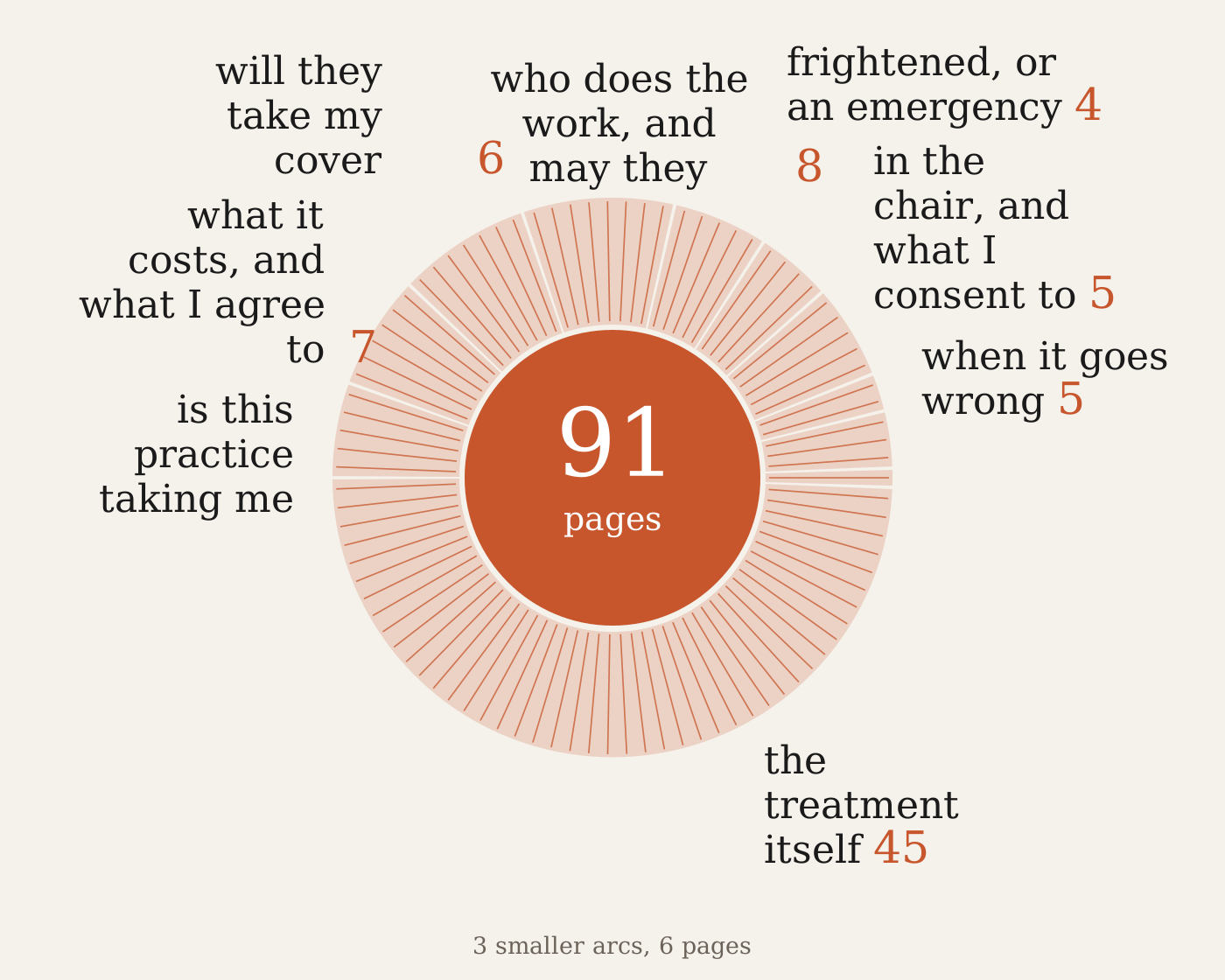
The treatment stage is half the map, and that is the correction that took three attempts to get right. See below.
Why it is this long, and not longer
One page per question a patient has to resolve, where a named source gives a different answer.
Not one page per procedure. Not one page per keyword. If the answer for a filling is the answer for a crown, it is one page. Whether a treatment hurts is two pages across the whole map, not twelve, because local anaesthetic works the same way whatever it is numbing.
A programme padded to two hundred pages by publishing one answer under fifteen headings is worth less than thirty that each answer something.
The service lines do not multiply this map, and that is a finding
Orthodontics, endodontics, implants, oral surgery: in California a general dentist may perform all of them. Business and Professions Code sections 1625 and 1626 define dentistry broadly and require one licence for the whole of it. Only the title specialist is regulated, under section 651(h), and only sedation requires a separate permit.
So “may a general dentist place implants” and “may a general dentist do braces” have the same answer from the same source. That is one page, not eight. A map that split it into eight would be padding.
But the treatment itself does multiply it, and we got that wrong twice
We first excluded clinical content as the practitioner’s craft. That was over-broad and it cost 45 pages. How a root canal is performed is craft and stays out. What a root canal is like for the patient is not craft, it is the thing the patient is actually searching for, and it was inside the entity all along.
The test that settles it: does recovery after an extraction have the same answer as recovery after an implant? It does not, and neither do how long each lasts, or what goes wrong with each. That is an axis, and it is the largest one in this map.
Every page on the map, listed
91 titles, and you can read every one of them. They are grouped the way the map is derived: by the stage of a patient’s course they answer, then by the question they belong to. Every branch shows its count. Collapse any of them to navigate; nothing is hidden on arrival.
Every title names the best source its question admits. That is the claim, and it is not the same as a percentage of statute. Wheelchair access and what a dental office has to provide is a question California law answers, in 28 C.F.R. pt. 36, and anything softer would be a failure. Nitrous, local and general, and what each actually is is a question no statute answers, and American Dental Association is the right source for it rather than a weaker one.
- 31 are answered by California statute, regulation or a published decision.
- 42 by a named professional body or agency, free to read and checkable in a minute.
- 2 sit behind a paywall, and the page names who owns them rather than going quiet.
- 16 have no named source, and say so.
75 of the 91 name a source, and none of them carries a weaker source than its question deserves. That second number is the one that matters: a question with a statutory answer that we have answered from something softer is unfinished work. A question with no statutory answer, answered from the body that actually studies it, is finished.
These branch counts include the shared questions as well as the claim-specific ones, so they run higher than the figures above, which count only what a kind of claim adds. Both are correct and they are counting different things.
Stage 1, is this practice taking me 5
- Whether a practice is accepting new patients, and why it may not be
- What accepting new patients means if you already have a plan
- Evening, weekend and early appointments, and what practices actually publish
- Wheelchair access and what a dental office has to provide (28 C.F.R. pt. 36)
- Getting seen when you have no dentist and something has broken
Stage 2, will they take my cover 6
- PPO, HMO and the difference that decides your bill (Health & Saf. Code 1340 et seq.)
- What we take your insurance actually means
- Who regulates your dental plan, and where a complaint goes (Health & Saf. Code 1341; Ins. Code 12921)
- The annual maximum, and why it runs out in October
- Denti-Cal: who qualifies and what is covered (Welf. & Inst. Code 14132(h); DHCS Provider Handbook)
- Membership and savings plans, and whether they are insurance at all (Health & Saf. Code 1345(f))
Stage 3, what it costs, and what I agree to 7
- What the codes on your treatment plan mean (ADA CDT (purchase required))
- Why two practices code the same work differently (ADA CDT (purchase required))
- A dentist may not lawfully treat you without a written plan (Bus. & Prof. Code 1684.5)
- What Denti-Cal pays for a procedure, published (DHCS Denti-Cal fee schedule)
- Financing and what you are signing when you take it (15 U.S.C. 1601; 12 C.F.R. pt. 1026)
- Why a dentist cannot pay anyone for referring you (Bus. & Prof. Code 650, 654)
- Discount plans advertised as though they were insurance (Bus. & Prof. Code 651)
Stage 4, who does the work, and may they 8
- Who is licensed to practise dentistry in California (Bus. & Prof. Code 1625, 1626)
- Checking a dentist’s licence and disciplinary record (Dental Board of California licence lookup)
- What a registered dental hygienist may and may not do (Bus. & Prof. Code 1907-1917)
- What a dental assistant may do, and what needs a licensed hand (16 C.C.R. 1085)
- When a dentist may call themselves a specialist (Bus. & Prof. Code 651(h))
- Who may sedate you, and the permit it takes (Bus. & Prof. Code 1646; 16 C.C.R. 1043)
- Sedating a child, and the rules that changed (Bus. & Prof. Code 1647.1 et seq.)
- Who actually owns the practice (Bus. & Prof. Code 1625.1-1625.4)
sedation also runs at in the chair, and what I consent to and the treatment itself.
Stage 5, in the chair, and what I consent to 5
- What informed consent has to cover (Cobbs v. Grant (1972) 8 Cal.3d 229)
- Infection control, and what the office must do (16 C.C.R. 1005)
- X-rays, how often, and who is allowed to take them (Health & Saf. Code 114870; 17 C.C.R. 30308)
- Amalgam, and the fact sheet you are owed (Bus. & Prof. Code 1648.10-1648.20)
- Nitrous, local and general, and what each actually is (American Dental Association)
amalgam also runs at the treatment itself.
sedation also runs at who does the work, and may they and the treatment itself.
Stage 6, frightened, or an emergency 4
- Dental anxiety, and what a practice can actually offer
- What counts as a dental emergency (American Dental Association)
- Out of hours, and who you actually reach
- Emergency care when you cannot pay (Welf. & Inst. Code 14132(h); DHCS)
Stage 7, when it goes wrong 5
- Complaining to the Dental Board, and what it can and cannot do (Bus. & Prof. Code 1670; Dental Board complaint process)
- Getting your records, and what they must hand over (Health & Saf. Code 123110)
- How long you have to sue a dentist (Code Civ. Proc. 340.5)
- Second opinions, and who pays for them
- When a bad outcome is negligence and when it is a known risk
Jurisdiction 2
- Local business licensing for a practice
- County oral health programmes and low-cost clinics (California Dept. of Public Health, Office of Oral Health)
Who the client is 3
- Consent for a child, and who may give it (Fam. Code 6500, 6922)
- Dental care in pregnancy, and the guidance practices follow (CDPH, Oral Health During Pregnancy)
- Veterans and dental cover
The hub 1
- The California dental patient map
The treatment itself 45
What it is, and when you need it 12
- What a filling is, and when a tooth needs one (American Dental Association)
- What a crown is, and when a tooth needs one (American Dental Association)
- What an onlay is, and when it is enough (American Dental Association)
- What a root canal actually treats (American Association of Endodontists)
- What scaling and root planing is, and why it is not a cleaning (American Academy of Periodontology)
- What an implant is, and what it replaces (American Academy of Implant Dentistry)
- What a bridge is, and what it rests on (American Dental Association)
- What a denture is, and what a partial is (American Dental Association)
- What sealants do, and who they are for (Centers for Disease Control and Prevention)
- What whitening does to a tooth (American Dental Association)
- What veneers are, and what they cost you permanently (American Dental Association)
- What braces and clear aligners actually move (American Association of Orthodontists)
How long it takes, and how many visits 8
- How many visits a crown takes, and why (American Dental Association)
- How long a root canal appointment runs (American Association of Endodontists)
- The implant timeline, and why it is measured in months (National Institute of Dental and Craniofacial Research)
- How long braces take, and what decides it (American Association of Orthodontists)
- How long aligner treatment takes (American Association of Orthodontists)
- A denture from impression to fitting (American Dental Association)
- Wisdom teeth: one visit or several (American Assoc. of Oral and Maxillofacial Surgeons)
- Gum treatment across quadrants, and why it is split
Recovery, and what you can eat 5
- Recovery after a simple extraction (American Dental Association)
- Recovery after a surgical or wisdom tooth extraction (American Assoc. of Oral and Maxillofacial Surgeons)
- Healing after an implant is placed (National Institute of Dental and Craniofacial Research)
- After gum surgery (American Academy of Periodontology)
- After a filling or a crown, and why it feels odd
How long it lasts, and what replaces it 6
- How long a filling lasts, and what replaces it (American Dental Association)
- How long a crown lasts (American Dental Association)
- How long an implant lasts, and what can still fail (American Academy of Implant Dentistry)
- How long a bridge lasts (American Dental Association)
- How long dentures last, and relining (American Dental Association)
- Retainers, and why teeth move back (American Association of Orthodontists)
What can go wrong 6
- Dry socket, and how to avoid it (American Assoc. of Oral and Maxillofacial Surgeons)
- When a root canal has to be redone (American Association of Endodontists)
- When an implant fails to integrate (American Academy of Implant Dentistry)
- When a crown comes off
- Sensitivity after treatment, and when it matters (American Dental Association)
- Relapse after orthodontics (American Association of Orthodontists)
Does it hurt 2
- What local anaesthetic does, and what you will feel (American Dental Association)
- When a procedure needs sedation rather than local (Bus. & Prof. Code 1646; 16 C.C.R. 1043)
sedation also runs at in the chair, and what I consent to and who does the work, and may they.
The comparison a patient actually searches 6
- Crown or onlay (American Dental Association)
- Implant or bridge (American Academy of Implant Dentistry)
- Implant or denture (American Dental Association)
- Root canal or extraction (American Association of Endodontists)
- Composite or amalgam (Bus. & Prof. Code 1648.10-1648.20)
- Braces or aligners (American Association of Orthodontists)
amalgam also runs at in the chair, and what I consent to.
Researched, and projected
91 titles are enumerated above, every one of them derived and taken to a source. The finished programme would land higher, and we are not going to tell you by how much.
The multiplier for this map is UNMEASURED. No page beneath this map has been researched yet. The multiplier is produced by a different act from deriving the map: it comes from reading a source for one question and noticing a question it does not answer, which cannot happen before the page beneath it is written. So this map has no outer layer, and that is a statement about the work done rather than about the subject.
We have a measured multiplier for one map and it is not this one. The personal injury map projects at 0.30 further questions per question researched, from 9 found while researching 30. That number belongs to that map. Quoting it here would be borrowing a measurement rather than making one, so this page states 91 derived and no projection.
Why this is a map and not a list
91 pages, and 78 links between them. The links are derived from the data rather than drawn by hand: a page declares what it is about, and two pages about the same thing at different points in the course are connected because they are, not because someone thought they looked related.
Take one page: After a filling or a crown, and why it feels odd. It connects to 5 others, and the links are not a guess: 4 are the same subject at another point in the course, across filling and crown, and 1 is a general answer its whole family reaches. Where each one sits is in brackets.
- What a filling is, and when a tooth needs one (the treatment itself)
- How long a filling lasts, and what replaces it (the treatment itself)
- How many visits a crown takes, and why (the treatment itself)
- How long a crown lasts (the treatment itself)
- What counts as a dental emergency (general, and every page in its family reaches it)
That is what the map buys you that a keyword list does not. Each of those pages makes the others easier to find, and a reader who arrives at any one of them has somewhere to go next that actually answers their next question.
The links run along one axis: the procedure. Here is how far each one reaches.
| what it is about | pages | where it runs |
|---|---|---|
| implant | 7 | the treatment itself |
| crown | 6 | the treatment itself |
| orthodontics | 6 | the treatment itself |
| extraction | 5 | the treatment itself |
| sedation | 5 | who does the work, and may they; in the chair, and what I consent to; the treatment itself |
| denture | 4 | the treatment itself |
| filling | 4 | the treatment itself |
| root-canal | 4 | the treatment itself |
| bridge | 3 | the treatment itself |
| gum | 3 | the treatment itself |
| amalgam | 2 | in the chair, and what I consent to; the treatment itself |
| onlay | 2 | the treatment itself |
| sealant | 1 | the treatment itself |
| veneer | 1 | the treatment itself |
| whitening | 1 | the treatment itself |
43 of the 91 sit on no subject at all, and that is correct rather than missing: they answer the same way whatever you are buying, so a link from one of them to another would be a link a reader would not follow.
Where this stands today
This is a demonstration map. It was derived to show how the method works, and there is no client engagement behind it. No practice commissioned it, nobody is paying for it, and none of its pages has been written, because writing them is not what it is for.
Every one of its 91 questions has been taken to a source, or recorded as having none. That is how we know the method runs rather than merely describes itself.
A client’s map is derived the same way and then built. This one stops at the map on purpose.
The method, briefly
The stages come from what a patient must resolve, in order. Each stage takes one page per question where a named source gives a different answer, and procedures that share an answer share a page. Every source is checked at its own address rather than assumed. Our method covers how we work in general.
If you want your own map derived, for the work your practice actually does, book a discovery call.